An evolutionary biology lab at the School of Biodiversity, One Health & Veterinary Medicine (University of Glasgow)
team lead: Prof. Kathryn R Elmer
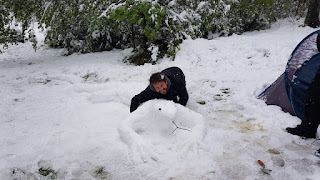
cold weather for fishing!
Get link
Facebook
X
Pinterest
Email
Other Apps
yikes, for most of last week Hans was fishing for gravid female whitefish in Loch Lomond. Cold hands but fun work! Finally, at least one of us is getting away from the computer this winter ...
Congratulations to Hans and our newest paper - "Differential reproductive investment in co-occurring oviparous and viviparous common lizards ( Zootoca vivipara ) and implications for life-history trade-offs with viviparity". A strength of this study is that it compares oviparity and viviparity reproduction from within the same geographic area and between sister lineages, therefore minimising the effects of environment and phylogeny. The paper is available open access from here, in Oecologia https://rdcu.be/bAGx7 Abstract Live-bearing reproduction (viviparity) has evolved from egg-laying (oviparity) independently many times and most abun-dantly in squamate reptiles. Studying life-history trade-offs between the two reproductive modes is an inherently difficult task, as most transitions to viviparity are evolutionarily old and/or are confounded by environmental effects. The common lizard ( Zootoca vivipara ) is one of very few known reproductively bimodal species, in which...
In a neat mix of some spatial genetic autocorrelation analyses (which I got excited about during my PhD on leaf litter frogs ) and life history strategies, we have published a new paper on oviparous and viviparous lizards. We find that even in the same environment, ie at the same site, the different parity modes have different scales of dispersal and different population densities. See details below. To do this study we reanalysed population level data collected in the study Hans led on the genomic basis of parity mode phenotypes now looking only at pure ovi/vivi individuals. This is unusual because most often these lineages are found in very different environments, which is a confound if we wanted to explore contrasts in their life histories and demographies. Parity-specific differences in spatial genetics and dispersal in the common lizard Abstract: Dispersal is a key demographic parameter that plays an important role in determining spatial population dynamics and genetic structure....
New paper from final year PhD student Nic Strowbridge. Nic's PhD looks at epitranscriptomics in different skin colour of salamanders. Methylation is a top new topic spurred on by advances in sequencing technology (which Nic is also using!) Using that momentum and finding lots of literature gap, Nic led this excellent and topical review paper. Check it out here - Open access! Nicholas Strowbridge, David R. Vieites, Michael G. Ritchie, Kathryn R. Elmer. 2025. Contributions of epigenomic and epitranscriptomic methylation to animal colouration. Trends in Genetics Abstract Due to its high variation and its diversity of functional roles, animal colouration has long been a fascinating phenotype for geneticists. While the loci underpinning colour are relatively well known, there remain components of unexplained variation. The contribution of DNA and RNA methylation to these molecular mechanisms of colouration is only now being explored. Recent research has shown that DNA (m 5...