Posts

Welcome to FSBI Intern Tie

Welcome to our FSBI Intern Tie Caribe, who has a busy summer ahead of lab work, husbandry, and and learning lots of new science! Congratulations on a successful award.

Welcome to the new summer Masters students

We welcome our summer project Masters students Allan Campbell, John Smout and Melissa Raske who are all working on molecular biotech projects, either in the field using in situ, rapid assessment with tests of the cool new qPCR-on-an-iPhone from biomeme, linking candidate genetic variants with local environments, or doing tissue-specific ecological transcriptomics in the lab. They have in intensive but exciting few months ahead!

Congratulations to Dr. Hans Recknagel!

Image
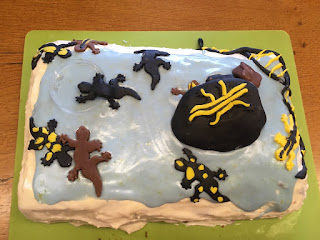
Congratulations to Hans, who successfully defended (="viva") his thesis on 22 April. With many thanks to the examiners and convenor, it was an interesting discussion and an exceptional thesis. Hans' research is on the ecology and evolution of reproductive modes, primarily using squamates as a model. His project was funded by an interdisciplinary Lord Kelvin-Adam Smith project with Kathryn Elmer (IBAHCM) and Nick Kamenos (Geography). There was also a pic of a lovely leaping lizard cake, but it is all gobbled up ...

Congratulations to Dr Madeleine Carruthers!

Image
A big congratulations to Madeleine for a successful PhD viva on her project on ecological transcriptomics and adaptive divergences in salmonid fishes! And here she is celebrating with a delicious charr cake. (tasted better than that sounds)

Congratulations to Dr James Burgon!

Image
Congrats to James Burgon for a very successful viva / PhD thesis defence for his project on 'how the salamander got his spots' on March 19th. And his colleagues made him a lovely thematic cake!

New pre-print on Arctic charr parallel evolution

Parallel evolution by non-parallel routes is a major fascination of mine. Here we have a pre-print submitted (and ms in the appropriate pipelines) about how such parallel evolution can happen, overcoming non-parallel backgrounds. The transcriptome! This is the outcome of a major group effort, including two PhD theses and many many years' worth of sampling ... Preprint at https://www.biorxiv.org/content/early/2018/02/14/265272.article-info Abstract:  Quantifying the extent to which evolution is predictable is critical to understanding biodiversity origins and its responses to future environmental challenges 1,2 . Replicate, or parallel, phenotypic evolution has been found in classic examples such as anole lizards, stickleback fishes, salmonid fishes, and cichlid fishes 3-8 and reflects similar adaptive outcomes. However it is not well understood if, how, and at what rate ecologically relevant phenotypic evolution can overcome the heterogeneous genetic backgro...

New paper: Colony breeding cichlids have itchy feet

Image
Very few fishes are colony breeding and so those that do are particularly interesting. In the clear waters of crater lake Apoyo, famous for its sympatric speciation of cichlids, the ‘short’ Midas cichlid have dense seasonal aggregations that breed and care for their young in beds of Chara algae. We wondered, why are they doing this? How does it relate to their family structures? Are males or females breeding where they were born or near their kin? We suspected that, given that the young babies are reared and tended in close proximity and with lots of brood swapping, that siblings might set up breeding territories close to each other. However, by sampling breeding pairs for genetic relatedness within and across multiple colonies, we discovered that there is no local genetic association. Nor does the biology differ, as patters are the same for males nor females. Our results suggest that strong philopatry or spatial assortative mating are unlikely to explain the rapid speciation pro...