Posts

Welcome to new lab members!

We welcome two new lab members for autumn 2021 - postdoc Morgane Bonade and PhD student Nic Strowbridge.  Morgane is working on the project 'do common lizards break Dollo's Law' by reversing back to oviparity? This is a NERC funded project that tests functionally - using genetic crosses, RNAseq, and phylogeny - some hypotheses put forward in our phylogenomic reconstruction that suggested reversal (open access paper here in MPE ).  Nic is an IAPETUS2 doctoral training programme student working on convergent evolution of colouration and toxicity defence in salamanders, in collaboration with Mike Ritchie at St Andrews.

New paper: Functional genetic basis of reproductive mode

Image
Our paper on the genetic basis of parity mode is now published. The functional genetic architecture of egg-laying and live-bearing reproduction in common lizards H. Recknagel, M. Carruthers, A. Yurchenko, M. Nokhbatolfoghahai, N.A. Kamenos, M.M. Bain, K.R. Elmer Nature Ecology and Evolution 2021 SharedIt link:  https://rdcu.be/cy5S2 All amniotes reproduce either by egg-laying (oviparity), which is ancestral to vertebrates, or by live-bearing (viviparity), which has evolved many times independently. However, the genetic basis of these parity modes has never been resolved and consequently its convergence across evolutionary scales is currently unknown. Here we leveraged natural hybridisations between oviparous and viviparous common lizards (Zootoca vivipara) to describe the functional genes and genetic architecture of parity mode and its key traits, eggshell and gestation length, and compared our findings across vertebrates. In these lizards, parity trait genes were associated with ...

New project: Evolution of reproductive mode

Image
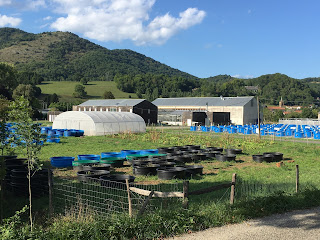
We are back in the field and setting up a new experiment on reproductive mode evolution! Delays due to covid are behind us and I'm thrilled to be at CNRS Station for Theoretical and Experimental Ecology  and starting our collaboration with ecology legend Jean Clobert.  First lizard pots are ready and lizards are arriving this week! This is a  NERC funded project  with Maureen Bain and Jean Clobert, and the collaboration of Hans Recknagel and new postdoc Morgane Bonade, to dig deeper into the functional development of oviparity in ancestral and derived lineages. Through this experiment we will directly tackle the thorny issue of putative reversal to oviparity ... do lizards break Dollo's Law? Also perfect timing for some momentum, as our major paper on functional genomics of oviparity vs viviparity is in press. Free online at  https://rdcu.be/cy5S2 more new soon!

New paper: reconstructing the history of viviparity in squamate reptiles

Image
 Recently published in the Journal of Evolutionary Biology -  Evolutionary origins of viviparity consistent with palaeoclimate and lineage diversification Hans Recknagel, Nicholas Kamenos, Kathryn Elmer freely available here a collaboration between evolutionary biology and Geography for reconstruction of palaeoclimate. It has long been argued that the origin of viviparity is related to cold climatic conditions. However this is challenging to disentangle correlation from causation, and response from cause. Also many studies have examined particular species groups but we have lacked the data so far to estimate a time tree in context of climate. Here led by Hans Recknagel in his interdisciplinary PhD studentship, we showed that stable and long-lasting cold climatic conditions are correlated with transitions to viviparity across squamates. Interestingly, this correlation of parity mode and palaeoclimate is mirrored by background diversification rate in squamat...

success with NERC standard grant and soon hiring

 We were recently awarded a three year NERC grant to study the evolution and development of reproductive modes, with common lizards as a model organism Check back early January if you are interested - we will be advertising for a postdoc soon! Reproductive mode evolution and reversal demonstrate the genetic toolkits of egg-laying and live-bearing Abstract: Laying eggs or giving birth to live young are two fundamentally different ways for females to produce their offspring. All birds, crocodilians, turtles, monotreme mammals (such as duck-billed platypus), and many lizards and snakes are egg-laying, as were most dinosaurs. In contrast, all placental mammals (like humans), marsupials, and some lizards and snakes are live-bearing. From studying embryos we know that many molecular and developmental aspects of these reproductive modes arose deep within the tree of life. For example, ancient egg-making structures are still retained within mammalian placenta, and the genes activated by pr...

PhD opportunities for autumn 2021

 We have several PhD opportunities through competition in the IAPETUS programme. Please see  Opportunities  page

New paper: cryptic diversity in Chinese minnows

 from his time as a visiting PhD student in our lab group, Li Chao has published an excellent paper on cryptic diversity and its taxonomic implications.  Cryptic species in White Cloud Mountain minnow, Tanichthys albonubes: Taxonomic and conservation implications Molecular Phylogenetics and Evolution https://doi.org/10.1016/j.ympev.2020.106950 Chao Li, Shuying Jiang. Kevin Schneider. Jinjin Jin, Hungdu Lin, JunjieWang, Kathryn R.Elmer, Jun Zhao Abstract: Cryptic species describe two or more species that had mistakenly been considered to be a single species, a phenomenon that has been found throughout the tree of life. Recognizing cryptic species is key to estimating the real biodiversity of the world and understanding evolutionary processes. Molecular methods present an unprecedented opportunity for biologists to question whether morphologically similar populations are actually cryptic species. The minnow Tanichthys albonubes is a critically endangered freshwater fish and was...